HomeEnglish news2026 New Taipei Smart City Forum Kicks Off. Focus on AI Dual Data Centers and Digital Twins to Build a Resilient City with Zero Downtime
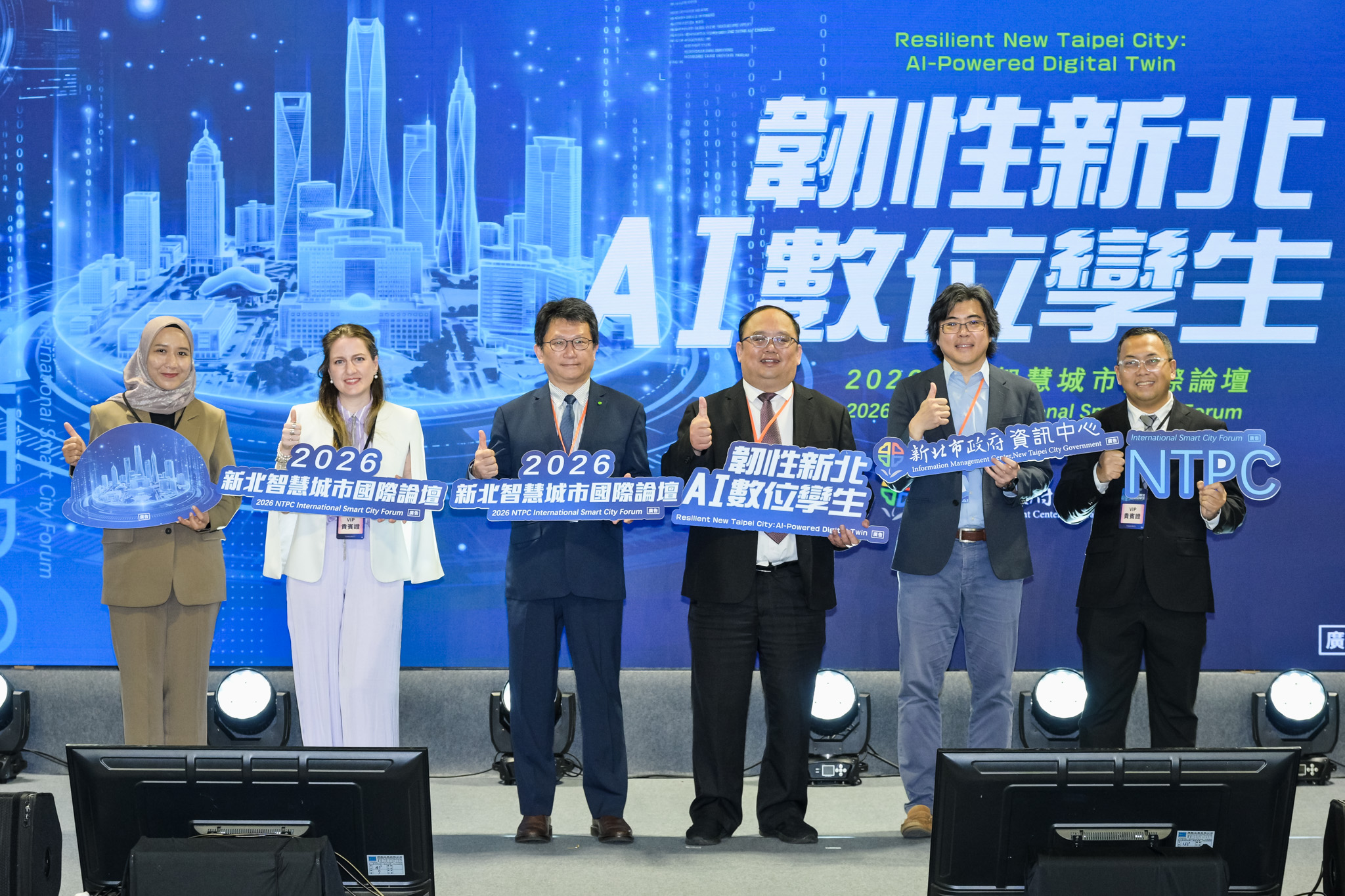
The New Taipei City Government Information Management Center hosted the 2026 New Taipei International Smart City Forum on June 24 at the AI TAIWAN Future Commerce Expo, held in the Yuanshan Expo Dome. Centered on the theme “Resilient New Taipei City: AI Powered Digital Twin,” the forum explored how cutting-edge technologies can be leveraged to build a model of urban resilience. Representatives from foreign missions in Taiwan, as well as leaders from industry, academia, and research, gathered for the event. The opening ceremony was presided over by Chen Fu-Tien, Director of the Information Management Center, officially underscoring New Taipei City’s determination to advance smart governance.
Director Chen Fu Tien said the forum serves as an important platform for New Taipei City to showcase its long-term technology strategy and forward-looking infrastructure planning. In the recently released 2026 Happy City Index, New Taipei City ranked 44th globally, placing first among all Taiwanese cities. Dr. Bartosz Bartoszewicz, Director of the Happy City Index, who personally visited New Taipei City last year, also recorded a video message for the forum. In the video, he highly commended the city’s top ranking in Taiwan, noting that such recognition was by no means accidental, but rather the result of sustained and visionary planning.
During the forum, Director of the Information Management Center, Chen Fu Tien, delivered an in-depth presentation on the AI data center planning for New Taipei City Government’s Second Administrative Center. The city government has built a dedicated data backbone by laying 8.8 kilometers of high-density dual-route, 96-core fiber-optic lines along the metro network, seamlessly connecting the First and Second Administrative Centers. This infrastructure creates ultra-high bandwidth and microsecond-level low latency, enabling dual data-center redundancy and true data symbiosis. The system also incorporates digital twin technology, which fully mirrors real-world operations in a virtual environment to simulate and test municipal scenarios. In the event of a natural disaster or sudden conflict, the system can switch instantly with zero downtime, ensuring the continuity of critical services such as disaster response, healthcare, and transportation. This demonstrates an exceptionally high level of urban operational resilience.
In the first keynote speech, Associate Professor Lu Ming-Ying from Soochow University’s Department of Data Science, who also serves as the Director of the Center for Big Data Analysis and Research, said that the AI computing platform established and integrated by the Information Management Center is a key enabler for cross-departmental collaboration and data sharing among industry, academia, and research institutions. By providing a shared computing environment and centralized operations and maintenance mechanism, the platform can effectively reduce the costs of duplicate infrastructure development across departments. He emphasized that computing power is the engine of urban intelligence, while data governance is the backbone of city operations. Only through shared computing resources and data collaboration can data truly become a common language for the city, allowing AI to deliver real value in public governance and further strengthen urban resilience.
Later, Chien Hung-Wei, Senior Executive Vice President of Deloitte Taiwan, drew on his extensive experience in the public sector and his long-standing role as an important contributor to Taiwan’s national cybersecurity and information policy. He noted that, supported by a solid foundation of 5G mobile networks, high-speed fiber-optic connectivity, and intelligent Internet of Things (AIoT), the introduction of AI will further drive a comprehensive upgrade of urban infrastructure and public services. Once this foundation is in place, AI can interact deeply with the city’s vast data resources. Through precise analysis of key indicators and early warning capabilities, AI can help the New Taipei City Government deliver more efficient and real-time public services, while also translating technology into smart living and smart safety, allowing citizens to experience smart governance that is more tangible, responsive, and human-centered in daily life.
Distinguished guests attending the international forum included Tamara Vér, Representative of the Hungarian Trade Office; Eko Wijanarko, Director of the Investment Department, and Wildatul Fitri Tatiara, Investment Department Analyst, both representing the Indonesian Economic and Trade Office to Taipei. Together, they joined this showcase of smart city innovation and technological exchange.
.jpg)